







Bad Bunny Celebrates Latin American Identities at the Super Bowl
February 9, 2026 Hour: 2:14 pm
🔗 Comparte este artículo
His performance transforms the U.S.’s biggest stage into a statement of cultural pride and resistance.
Bad Bunny’s transformation from supermarket worker in Vega Baja to global superstar is not just a story of musical success; it’s also a cultural and political one.
RELATED:
Bad Bunny Celebrates Latin American Culture at the Super Bowl Despite Conservative Backlash
This article explores how he has redefined global pop music by embracing his Puerto Rican identity and using reggaeton as a tool of resistance and pride.
From his early days with Rimas Entertainment, to activism during Puerto Rico’s 2019 protests, to the release of his 2025 album, Debí Tirar Más Fotos (DTMF), to his historic performance at the 2026 Super Bowl, Bad Bunny has proven that Latin American art can challenge empire, defend independence, and reshape global culture without losing its roots.
From Econo Packer to Cultural Shield: The Roots of Benito
The story of Benito Antonio Martínez Ocasio, better known as Bad Bunny, is not one of manufactured pop stardom. Born in 1994, he hails from a working-class family in Vega Baja, Puerto Rico.
Before topping the global charts, he was a student at the University of Puerto Rico who worked as a supermarket packer at Econo. He would upload his early songs to SoundCloud after his shifts.
What sets Bad Bunny apart from other Latin icons is his refusal to play by the traditional rules of the U.S. market.
While many artists sign restrictive contracts with major record labels, Bad Bunny built his empire through Rimas Entertainment, an independent label that keeps creative and financial control in Latin American hands.
Since 2016, he has redefined urban music by topping the Billboard 200 while singing exclusively in Spanish. In doing so, he has proven that the Caribbean can lead the global stage without surrendering its identity.
Beyond his music, Benito’s public persona is a political act. By defying gender and fashion norms, wearing skirts, painting his nails, and breaking hypermasculine reggaeton stereotypes, he transforms his image into a cultural shield.
His visibility lends legitimacy to marginalized identities and challenges the conservative values often imposed by cultural centers of power.
The Soundtrack of the Street: Music as a Political Tool
For Bad Bunny, reggaeton is more than just a way to make hits; it is a political language and a tool of resistance.
His activism became apparent during Puerto Rico’s summer of 2019, when mass protests forced Governor Ricardo Rosselló to resign following the leak of misogynistic and homophobic messages.
Instead of staying silent, Bad Bunny paused his European tour to join the protesters on the island. He co-wrote “Afilando los Cuchillos,” a protest anthem that energized what he called “the I Will Not Give Up Generation.”
His 2025 album, Debí Tirar Más Fotos (DTMF), marked a turning point by blending art, politics, and social commentary into one manifesto.
Through his music, Bad Bunny denounces the ongoing dispossession of Puerto Rico by addressing several key themes:
- Gentrification and displacement: In tracks like “El Apagón” (Un Verano Sin Ti) and others on DTMF, he criticizes Law 22, which allows wealthy foreigners to move to Puerto Rico for tax breaks while displacing local communities.
- Energy sovereignty: He exposes the island’s energy crisis, which was caused by privatization under LUMA Energy. He uses real recordings from power plants to highlight government neglect.
- Gender violence: Through songs like “Andrea,” he honors victims of femicide, such as Andrea Ruiz Costas, and questions the colonial institutions that fail to protect women.
By combining traditional rhythms like bomba and plena with modern trap, Bad Bunny resists cultural erasure.
His message is clear: Without reggaeton, there is no revolution. He transforms pop culture into a vehicle for political awareness, inspiring millions to dance and awaken.
Challenging the Empire: Independence, ICE, and Colonial Reality
Bad Bunny’s activism extends beyond his lyrics. He directly challenges U.S. imperial structures. He uses his global platform to advocate for Puerto Rican independence, describing the island’s relationship with the U.S. as modern-day colonialism rather than a partnership.
He criticizes both the PROMESA Act and the Fiscal Control Board, which many view as instruments of debt dependency enforcement.
He is also one of the few global Latin artists to openly challenge ICE (Immigration and Customs Enforcement). During his 2026 Grammy acceptance speech for Album of the Year, he called for ICE’s removal, insisting, “We are not savages, we are human beings, and we are Americans,” referencing the shared Latin American identity.
His stance was not just symbolic. Initially, Benito refused to tour the United States for DTMF, fearing that his concerts could become targets for ICE raids.
He said he would rather perform in Puerto Rico than risk seeing immigrant families torn apart outside a stadium.
“I’m not going to take my party to a place where my people don’t feel safe. If ICE is going to be outside waiting for the concert to end so they can arrest people who just came to dance, then there won’t be a concert.” —Bad Bunny, 2025.
This decision solidified his reputation as an artist driven by moral principles rather than commercial interests.
The Super Bowl: Occupying the Center of the Empire
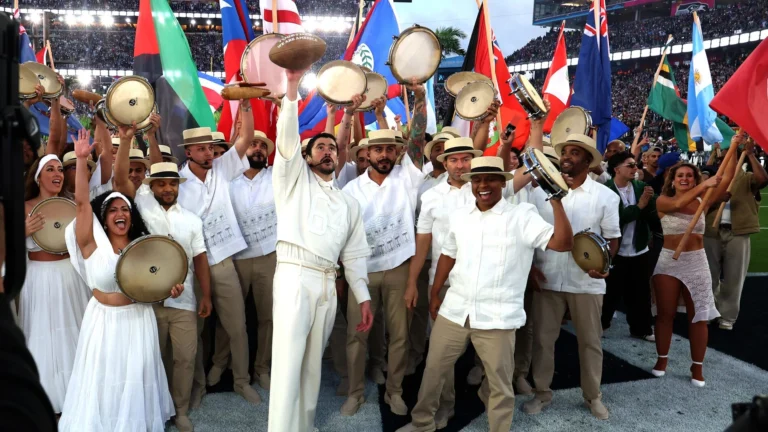
In February 2026, Bad Bunny brought his message right to the heart of U.S. pop culture at the Super Bowl. His performance at Super Bowl LX was not an act of submission, but rather a symbolic occupation.
His performance made history as the first entirely Spanish-language halftime show in NFL history, forcing a global audience to confront the power of Latin identity on its own terms.
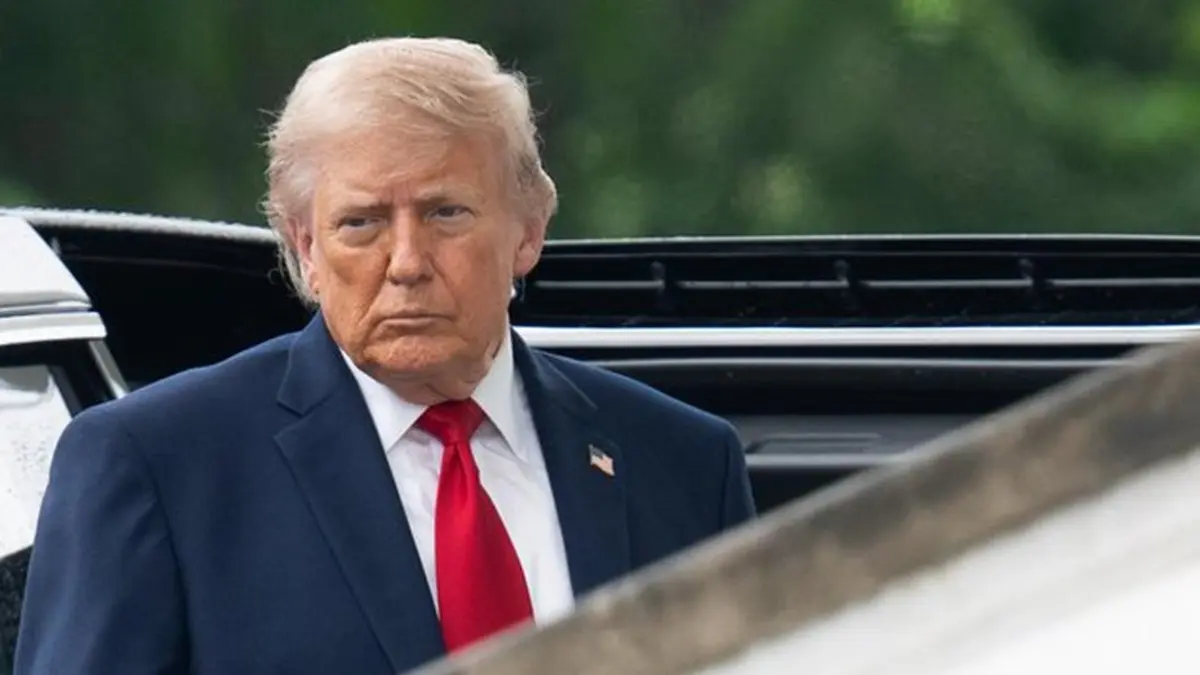
Conservative figures, including Donald Trump, reacted with outrage, calling the performance “a slap in the face” to America.
However, Bad Bunny stood firm, telling the English-speaking public that they had “four months to learn Spanish.” He refused to translate his art to gain acceptance.
His performance was full of symbolism:
- Aesthetics of the “platabanda”: Instead of high-tech futurism, the stage incorporated visual elements of popular Caribbean architecture, such as the “flat-roof” (platabanda) house. This reclaimed the aesthetics of the working class against the hegemony of aspirational luxury.
- Redefining “America”: At the show’s conclusion, Benito held a ball bearing the phrase “Together we are America,” while the screen displayed, “The only thing more powerful than hate is love.” This was a radical act of linguistic and geographic reappropriation, asserting that the continent of America extends far beyond the borders of the United States.
- Linguistic sovereignty: By refusing to perform in English or include Anglo-Saxon guests, Benito forced the global audience to consume his art on his own terms. His performance was entirely in Spanish, directly challenging U.S. cultural hegemony and the “demand for assimilation.”
It was not just a musical performance, but a cultural revolution broadcast live. For millions in the diaspora, it meant seeing themselves represented unapologetically at the heart of American entertainment.
It signaled a new chapter in how Latin America defines and redefines the meaning of “America.”
The Future of Latin American Soft Power
Bad Bunny’s evolution reveals much more than fame; it demonstrates how cultural production can transform political narratives.
By refusing to change himself for the sake of global approval, he has proven that Latin artists can take center stage without compromising their identity.
His rise embodies a new form of soft power: a Caribbean artist influencing global consciousness directly.
Through music, activism, and defiance, he has reclaimed Puerto Rico’s narrative from those who have tried to erase it.
His voice is now more than entertainment; it is a tool of diplomacy, identity, and resistance. As he continues to use his art as a cultural shield, he represents a generation that refuses to be colonized, silenced, or oversimplified.
For Latin America, his success is more than an individual triumph. It signals a shift in global power dynamics.
The Latino community is no longer a silent minority, but rather a political and cultural force that is shaping its own destiny.
Bad Bunny’s legacy is clear: Reggaeton is not just dance music; it is a language of resistance. Through it, the Caribbean and Latin America loudly declare their presence, pain, and power to the world.
Sources: BBC – New York Times – EFE – Julio Magazine – CEDES – El Diario – Latin Spot
Author: Silvana Solano
Source: teleSUR